




Trademarks protect your unique brand identity and intellectual brand property, preventing marketplace confusion. You can now strengthen the protection of your brand identity through the expert trademark registration online process that reduces the risk of brand conflicts, rebranding costs, and other customer-related confusion.
We are your trusted partner for streamlined trademark filing and registration-related process support. Starting from comprehensive research & applications to monitoring & maintaining renewals, our trademark registration consultants provide you with expert end-to-end solutions.
TM
SM
R
C
When there is a TM on the brand name or logo, it indicates that the trademark application has been filed and the registration is under process. An applicant can use the TM beside his brand name or logo once the application is filed. He can use it until the registration is done. After completion of registration, the TM gets replaced by ® which means the trademark registration is completed and it is valid for 10 years.

Trademarks are distinctive letters, words, phrases, symbols, designs, or a combination thereof, used by individuals or businesses to distinguish their goods or services from those of others. Governed by the Trade Marks Act 1999, trademark registration not only serves as an important identifier of brand origin that can help protect your brand identity from unauthorised use, but also enhances brand differentiation and recognition and helps strengthen your market presence through the protection available under applicable laws.
Any individual or legal entity, including proprietorships, partnerships, LLPs, companies, trusts, and societies, claiming to be the proprietor of a trademark may apply for the process of trademark registration in India. Trademark applications are generally filed using Form TM-A through the IP India portal along with the applicable government fees. After a successful filing, an application number is generally generated, enabling applicants to track the status of their application. Applicants may use the ™ symbol in connection with their mark to indicate a claim of trademark rights.
The time required for trademark registration may vary depending on factors such as examination, objections, oppositions, hearings, and other administrative processing. The ® symbol may generally be used only after the trademark has been successfully registered in accordance with applicable laws.
Any individual claiming to be the proprietor of a trademark may apply for trademark registration in India. Individuals can apply for trademarks relating to existing or proposed goods and services, subject to applicable legal requirements and examination by the Trademark Registry.
Two individuals or entities may jointly opt for the trademark online application process where joint ownership of the trademark is claimed. In this case, the application should clearly identify all co-applicants.
A partnership firm may apply for trademark registration in India in the names of all partners constituting the firm. The application should contain the relevant details of the partners in accordance with applicable requirements.
A Limited Liability Partnership (LLP) should file the trademark application in the name of the LLP, which is recognised as a separate legal entity. The trademark rights, if granted, belong to the LLP.
A company incorporated in India, including a private limited company, public limited company, or other incorporated entity, may file a trademark application in its own name. Where the trademark belongs to the company, the company should be named as the applicant.
Foreign entities may apply for trademark registration in India in their registered corporate name, subject to compliance with applicable laws and documentation requirements.
A trust or society may opt for the process of trademark registration through its authorised representative, such as the managing trustee, chairman, secretary, or other duly authorised office bearer, as applicable.
Indian Trademark Law recognises several categories of trademarks depending on the nature of the mark as well as its intended use. Some of these commonly recognised categories include:
A service mark is used to identify and distinguish the services of one business or individual from those of others. Trademark applications relating to services are generally filed under Classes 35 to 45 of the Nice Classification system.
A series mark consists of a group of trademarks that closely resemble one another and differ only in non-distinctive elements, while retaining the same essential characteristics. Such marks may be registered as a series subject to the applicable legal requirements.
A sound mark is a distinctive sound used to identify and distinguish the goods or services of a particular business or individual. Sound logos, jingles, and audio identifiers may qualify for protection as sound marks, subject to compliance with applicable trademark requirements.
Trademark registration can offer several benefits to businesses that seek to protect and strengthen their brand identity, some of which are mentioned here in
A registered trademark may provide the owner with exclusive rights to use the mark in relation to the goods or services for which it is registered, subject to applicable laws. Registration may also enable the proprietor to take appropriate legal action against unauthorised use or infringement where permitted under the law.
A registered trademark can help consumers identify the source of goods or services and may contribute to stronger brand recognition in the marketplace. Over time, consistent use of a trademark may help businesses build customer confidence and loyalty.
Trademarks help distinguish a business's goods or services from those of competitors. A distinctive trademark or logo can assist customers in identifying a brand and recognising its products or services in the marketplace.
The process of Trademark registration in India helps reinforce a brand's unique identity and supports the protection of brand elements such as names, logos, and other distinctive marks. This can contribute to a stronger and more recognisable market presence.
A registered trademark is a form of intellectual property and may become a valuable business asset. Subject to applicable laws and contractual arrangements, trademarks may be licensed, assigned, franchised, or otherwise commercially utilised.
Once a trademark is successfully registered, one may use the ® symbol in connection with the registered mark. The symbol further indicates that the trademark is registered and may help notify others of the proprietor's registered rights. Subject to applicable laws, the proprietor may also be entitled to pursue legal remedies against unauthorised use or infringement.
Trademark registration may strengthen a proprietor's ability to protect the registered mark against unauthorised use, infringement, or deceptive practices, subject to the provisions of applicable laws. It can also help safeguard the distinct identity associated with a brand.
A registered trademark remains valid for ten years from the date of registration and may be renewed periodically in accordance with applicable legal requirements. This enables businesses to maintain protection for their trademarks over the long term, subject to timely renewal.
A trademark registration process in India may support businesses seeking trademark protection in other jurisdictions, subject to the laws and registration requirements of the respective countries. It can also contribute to building and protecting brand identity across multiple markets.
A registered trademark is an intellectual property asset that may contribute to the overall value of a business. Subject to applicable laws and contractual arrangements, trademarks may be licensed, assigned, franchised, or otherwise commercially utilised.
The Trade Marks Registry is responsible for administering trademark registration and related matters in India under the Trade Marks Act, 1999. It examines trademark applications, maintains the register of trademarks, and oversees various procedures relating to trademark protection and registration.
The headquarters of the Trade Mark Registry in India are in Mumbai, with branch offices in Delhi, Ahmedabad, Chennai, and Kolkata. Trademark applications are filed under the provisions of the Trade Marks Act, 1999 and examined by the Trade Marks Registry before registration may be granted.
Goods and services are categorised into 45 trademark classes under the internationally recognised classification system. Classes 1–34 generally relate to goods, while Classes 35–45 relate to services. Selecting the appropriate class or classes is an important part of the trademark registration process, as the scope of protection generally depends on the goods and services covered by the application. Businesses offering products or services across multiple categories may consider applying in all relevant classes.
Some commonly used trademark classes include:
There are some steps involved in the plan of trademark registration-
Applicants should choose a distinctive trademark capable of distinguishing their goods or services from those of others. Identifying the appropriate trademark class or classes is also an important part of the process. At present, there are a total of 45 categories of products and services for which you can file a trademark application. Classifications 1–34 are for products, whereas classes 35–45 are for services.
Before trademark filing in India, it is generally advisable to conduct a trademark search to identify potentially similar or identical marks that may already be registered or pending registration. Public trademark search facilities are available through the official Trade Marks Registry portal.
Once the trademark and relevant class(es) have been identified, you may file a trademark application under the Trade Marks Registry in the prescribed form along with the applicable fees.
Once you've decided on a mark, you should run a search to see if it's comparable to an already registered mark. You may do this yourself by visiting the Controller General's website for Patents, Designs, and Trademarks. A public search option is available on the website. After selecting this option, you must select your class and search the online database.
Trademark applications are generally filed using Form TM-A through the Trade Marks Registry. Depending on the nature of the application and the applicable legal requirements, applicants may seek trademark registration in one or more classes, subject to the provisions of the Trade Marks Act, 1999 and related rules.
Applicants should ensure that all information provided in the trademark application is complete and accurate, as errors, omissions, or inconsistencies may lead to delays, objections, or other procedural requirements during examination. Where applicable, representations of the trademark and supporting documents must be submitted in the prescribed format.
Government fees, trademark filing requirements, and procedural guidelines may vary from time to time in accordance with applicable laws and notifications issued by the relevant authorities.
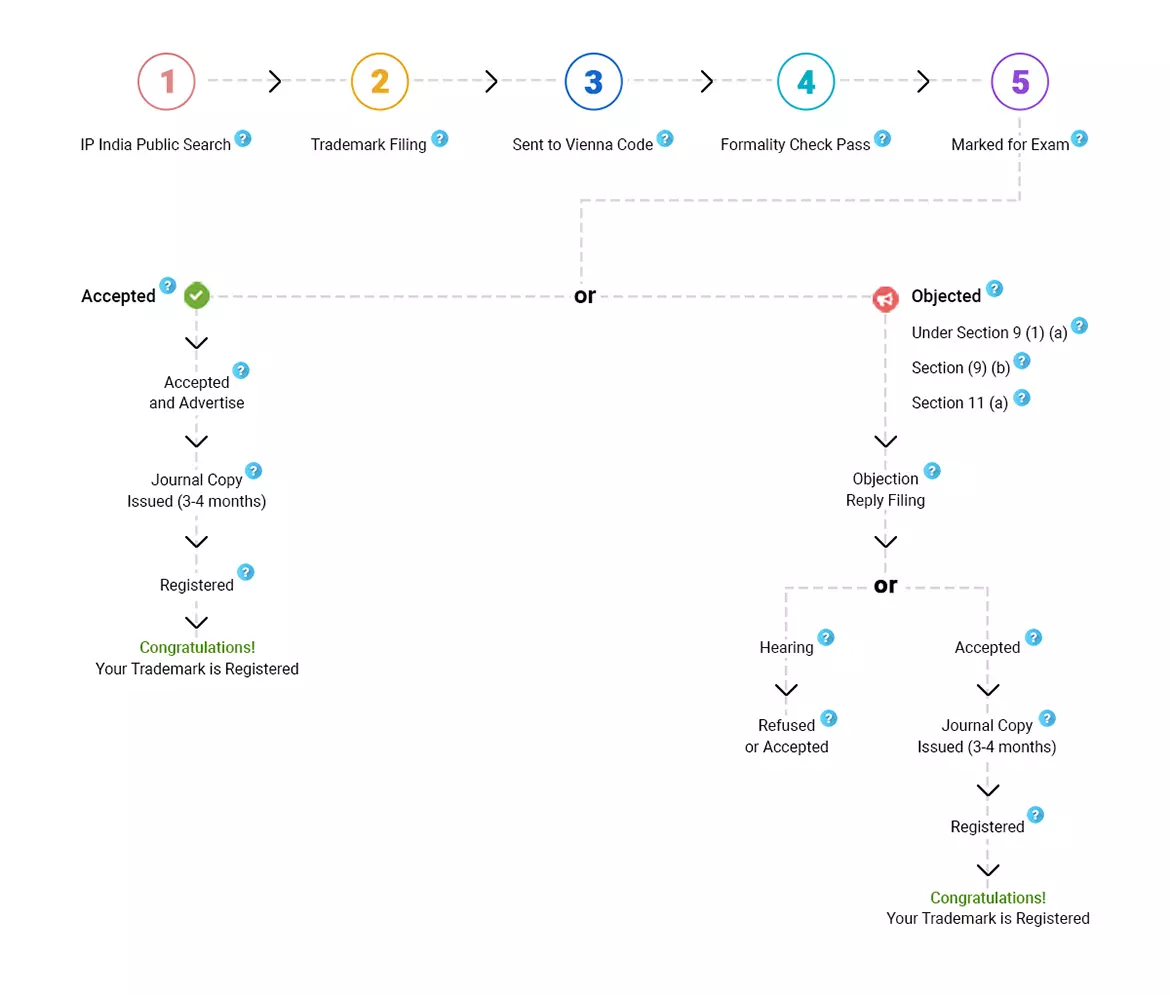
The Vienna Classification is an internationally recognised system used for classifying the figurative elements of trademarks. It was established under the Vienna Agreement and assists trademark offices in categorising visual components such as shapes, symbols, animals, plants, and other design elements. This is completed with a written account, sanctioning trademark searches to be conducted for logos/artworks.
The "Formalities Chk Pass" status indicates that a trademark application has cleared the Trade Marks Registry's initial administrative scrutiny, including verification of prescribed filing requirements, applicable documents, fees, and other procedural compliances. If these requirements are not met, the status may appear as "Formalities Chk Fail," requiring rectification.
Word mark (word per se) applications generally proceed directly to examination, while applications containing logos or other figurative elements are ordinarily assigned a Vienna Classification before examination. Processing is generally based on the filing priority, although timelines may vary depending on administrative and procedural factors.
The Trade Marks Registry examines the application to determine compliance with applicable legal requirements. The Registry may raise objections or seek clarifications where necessary.
Subject to successful completion of the applicable procedures and requirements, the trademark may proceed toward registration in accordance with the provisions of the Trade Marks Act, 1999.
The trademark registration online process generally includes the stages, provided hereunder:
Before filing a trademark application, it is advisable to conduct a trademark search to identify existing registered or pending trademarks that may be similar to the proposed mark. Choosing a distinctive trademark can help reduce the likelihood of objections during the registration process.
Applicants are generally required to provide information and supporting documents relevant to the trademark application. The specific documentation requirements may vary depending on the nature of the applicant and the trademark being filed.
The trademark application is typically filed using Form TM-A through the Trade Marks Registry. Applications may be submitted electronically or through other prescribed modes, subject to the applicable filing procedures.
After filing, the Trade Marks Registry examines the trademark application and whether it complies with the provisions of the Trade Marks Act, 1999 and related rules. The Trade Mark Registry may issue examination reports, objections, or requests for clarification where necessary.
If the application is accepted for publication, the trademark is advertised in the Trade Marks Journal. During the prescribed opposition period, third parties may have an opportunity to oppose the registration in accordance with applicable laws.
Where an opposition is filed, the parties are required to submit responses, supporting evidence, and participate in hearings or other proceedings as prescribed by the applicable rules. The Trade Marks Registry considers the submissions of all parties before making a decision.
Upon the successful completion of all applicable procedures and legal requirements, the trademark may proceed to registration. After the process of registration, the proprietor may use the ® symbol in connection with the registered trademark in accordance with applicable laws.





A trademark is a distinctive sign, word, logo, symbol, phrase, or combination thereof that helps identify and distinguish the goods or services of one business from those of others. A registered trademark is an intellectual property asset that helps protect the brand identity and goodwill associated with your business.
Trademark registration provides the owner with certain legal rights under applicable trademark laws, including the ability to take legal action against unauthorised use or infringement of the registered mark. It also helps prevent others from registering or using identical or deceptively similar trademarks in relation to similar goods or services, subject to applicable legal provisions and circumstances.


I recently used Online Legal India for trademark registration, and the process was seamless from start to finish. The team was professional, responsive, and explained every step clearly. I got my application filed quickly without any hassle.
I'm so glad I chose Online Legal India to register my brand's trademark. Their online process saved me time and effort, and their pricing was very reasonable. The expert assigned to me was knowledgeable and very helpful throughout the process. Definitely a five-star experience!
As someone new to the world of trademarks, I had no idea where to begin. Online Legal India not only guided me through the documentation and process but also ensured my application was filed correctly and on time. They really made things easy for me. Thank you for your fantastic service!
I had a great experience with Online Legal India’s trademark registration service. Everything was transparent—no hidden charges, and the team kept me updated at every step. I appreciate the professionalism and follow-ups. My trademark application is now under process, and I feel confident it’s in good hands.
From document submission to final application, the entire process was smooth. The support team was courteous and answered all my queries promptly. I’ve already recommended Online Legal India to a few of my business associates. If you’re looking to register your trademark online, look no further!


 1999
4999 11999 14999 3999 5999
1999
4999 11999 14999 3999 5999
1999
4999 11999 14999 3999 5999
1999
4999 11999 14999 3999 5999 

The Founder & CEO of Online Legal India, Mr. Rajesh Kewat actually had the courage to sacrifice his well paid job at Oxford and turn his startup dream into a multi crore turnover company.

Meet Rajesh Kewat, The Small Town Entrepreneur Behind Online Legal India's Success

From Rs. 2000 Salary to Multi-Crore Turnover Company | Rajesh Kewat | TEDxPradhikaran.

Mr. Rajesh Kewat getting featured in the special edition of Forbes India Magazine - Showstoppers 2022-23

Rajesh Kewat, the MD of FastInfo Legal Services Pvt Ltd, owns a movie-like story; a man who lost everything for his love & attained great success within just 500 days with his innovative business.

Rajesh Kewat Conferred with Businessman of the Year Award at Brands Impact NFA 2022.



‘You don’t need MONEY to build your business empire, what you need is big dreams & a SHARP MIND! If you got it, try it.’

Trademark registration grants the registered proprietor certain exclusive rights to use the trademark in relation to the goods or services for which it is registered, subject to applicable laws.

A registered trademark may provide a basis for taking legal action against unauthorised use or infringement of the registered mark, in accordance with applicable laws and procedures.

Trademark registration helps distinguish your products or services from those of competitors and can reduce the likelihood of consumer confusion in the marketplace.

A registered trademark is an intellectual property asset that may be licensed, assigned, franchised, or otherwise commercially utilised, subject to applicable legal requirements.

A trademark registered in India may serve as a foundation when seeking trademark protection in other jurisdictions, subject to the laws and registration requirements of those countries.

A registered trademark can help strengthen brand identity, enhance market recognition, and contribute to the goodwill associated with a business over time.
How Will The TM Expert Process Your Trademark Registration?
Fill out our registration form and complete the applicable payment process.
⟶
Our team will assist in identifying the appropriate trademark class(es) based on the details of your brand, goods, or services.
⟶
We will prepare the necessary authorisation document(s), including Form TM-48, where applicable.
⟶
Upload the required documents and information needed for processing your trademark application.
⟶
Our team will assist with the preparation and filing of the trademark application with the Trademark Registration.
⟶
Once your trademark application is successfully filed and an Application Number is generated, you may generally use the ™ symbol in connection with your applied mark.
👍

5 Lakh+ Happy Clients Across India

ISO Certified

Data Security & Trust

Trained & Professional Experts

On Time Service

Super Fast Service

Quick Response Team

Affordable







A trademark is a unique brand identifier, like a logo or name, that helps companies distinguish their goods from competitors in the market. If the brand provides services rather than products, the identifier is officially known as a service mark.